RANOSEMI

Home

Case studies

About

Contact

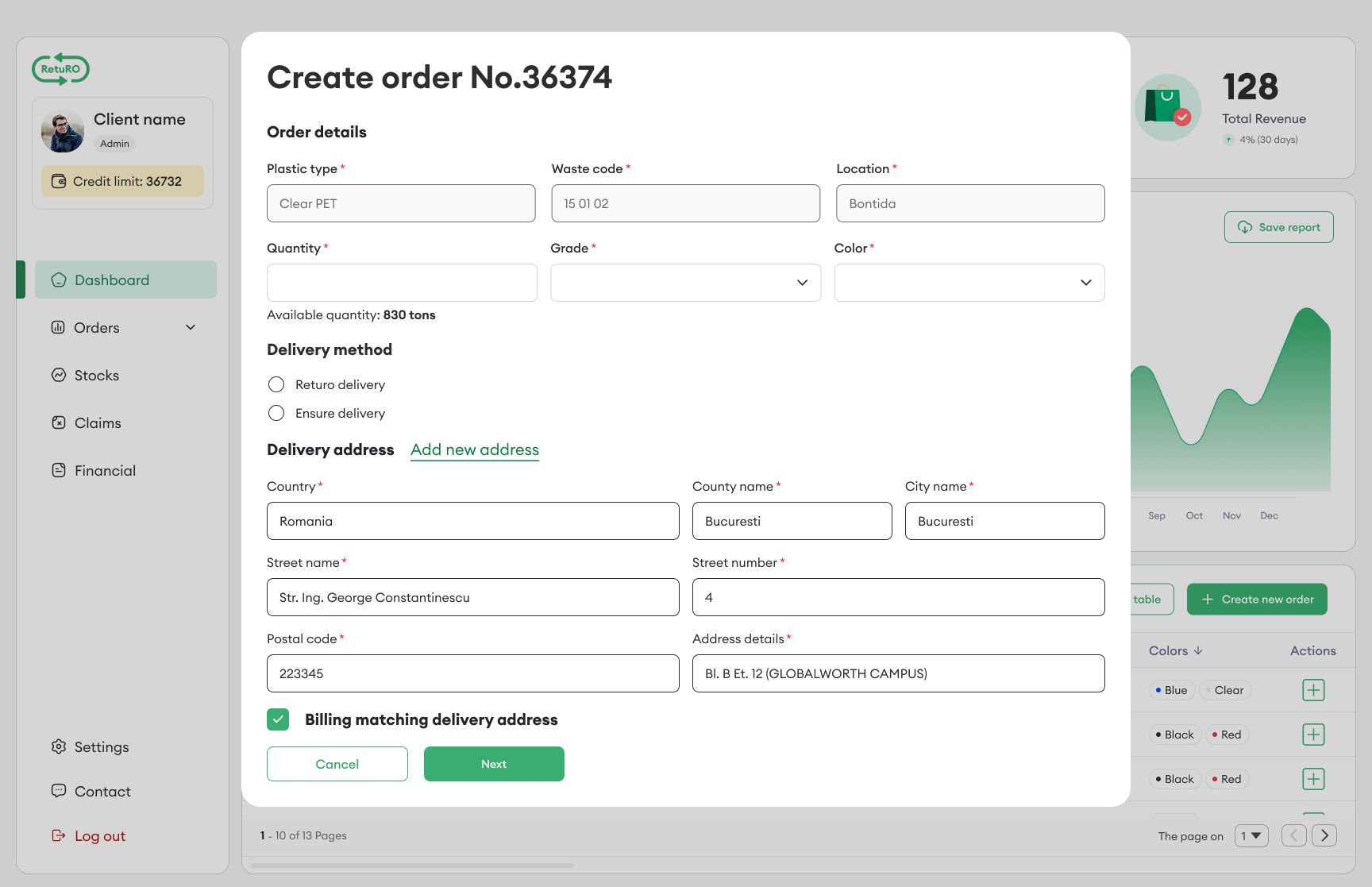
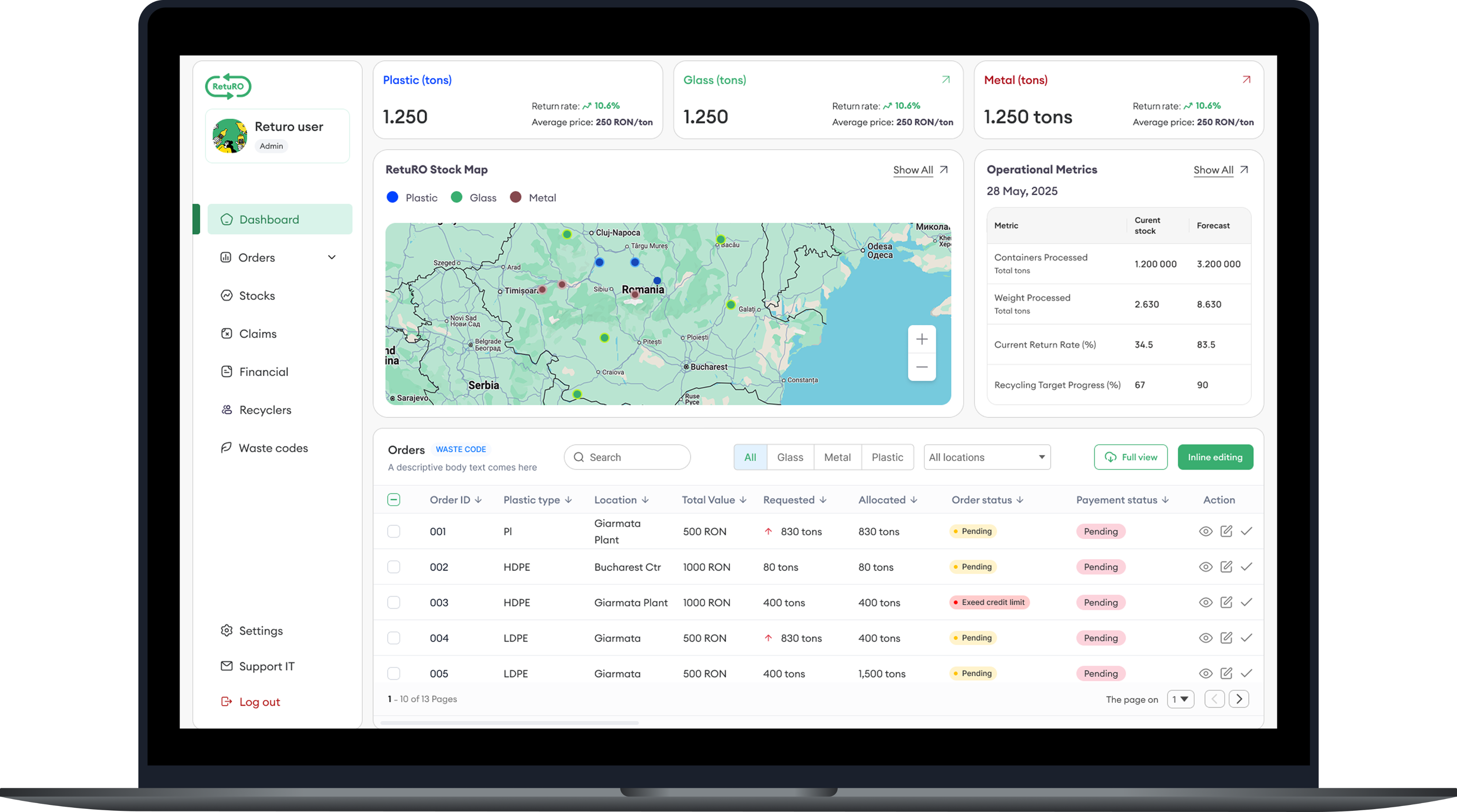
Returo dashboard

Automated solution for sales of finished goods to recyclers

Sole UX Designer · Tremend Proposal

Circular Economy · Waste Management

Discovery Workshop · Service Blueprint · Low-fidelity Prototype

Web · B2B Enterprise

IMPACT AND LEAD OUTCOME

Designed as part of a competitive RFP response for Romania's national deposit-return system administrator. All metrics represent design targets established through research benchmarking and client brief analysis.

40%

Shift offline→digital checkout buyers

30%

Cross-sell upsell conversion increase

25%

Reduction in system downtime

50%

Faster task completion through AI-driven interfaces

95%

App store rating target

3→1

App store rating target

CONTEXT

The challenge

RetuRO SGR is Romania's government-appointed administrator of the national Deposit-Return System, managing the collection, sorting, and sale of plastic, metal and glass across multiple national centres. The project required a fully integrated platform connecting recyclers, commercial managers, and IT teams — with deep integration into Microsoft Dynamics and UI deliverables constrained by DRUPAL's rendering limitations.

My contribution

I contributed across product strategy and UX— from market research, KPI definition, andpersona development through journey mapping,UX enhancement strategy, and high-fidelitymobile screen design. Part of the front-endand mobile design lead at Tremend · Publicis.

DISCOVERY

Service blueprint

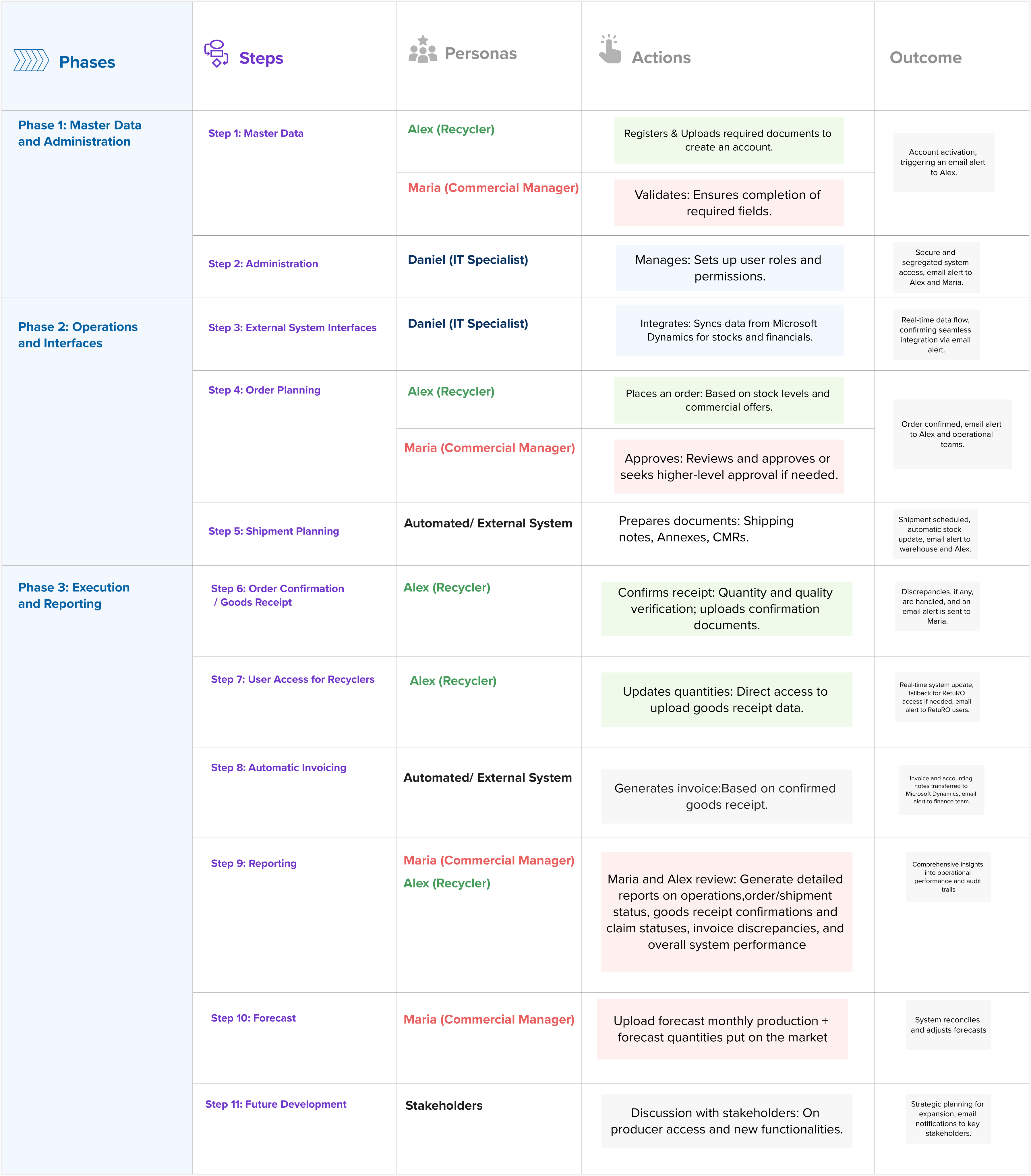
To map the full complexity of RetuRO's sales process, I created a service blueprint covering three operational phases and eleven steps — from master data administration through to reporting and forecasting. Each step was mapped against the three user personas and automated system touchpoints, making visible where handoffs, delays, and validation bottlenecks occurred.

Semantic naming

Semantic naming

Semantic naming

Artefact: Mural service blueprint image with persona swimlanes
USER RESEARCH - PERSONAS

Three distinct user types with divergent platform needs

Persona insights were derived from RFP documentation and stakeholder analysis rather than direct user interviews — a constraint of the proposal context that I navigated by grounding each persona in the operational responsibilities and pain points described in the client brief.
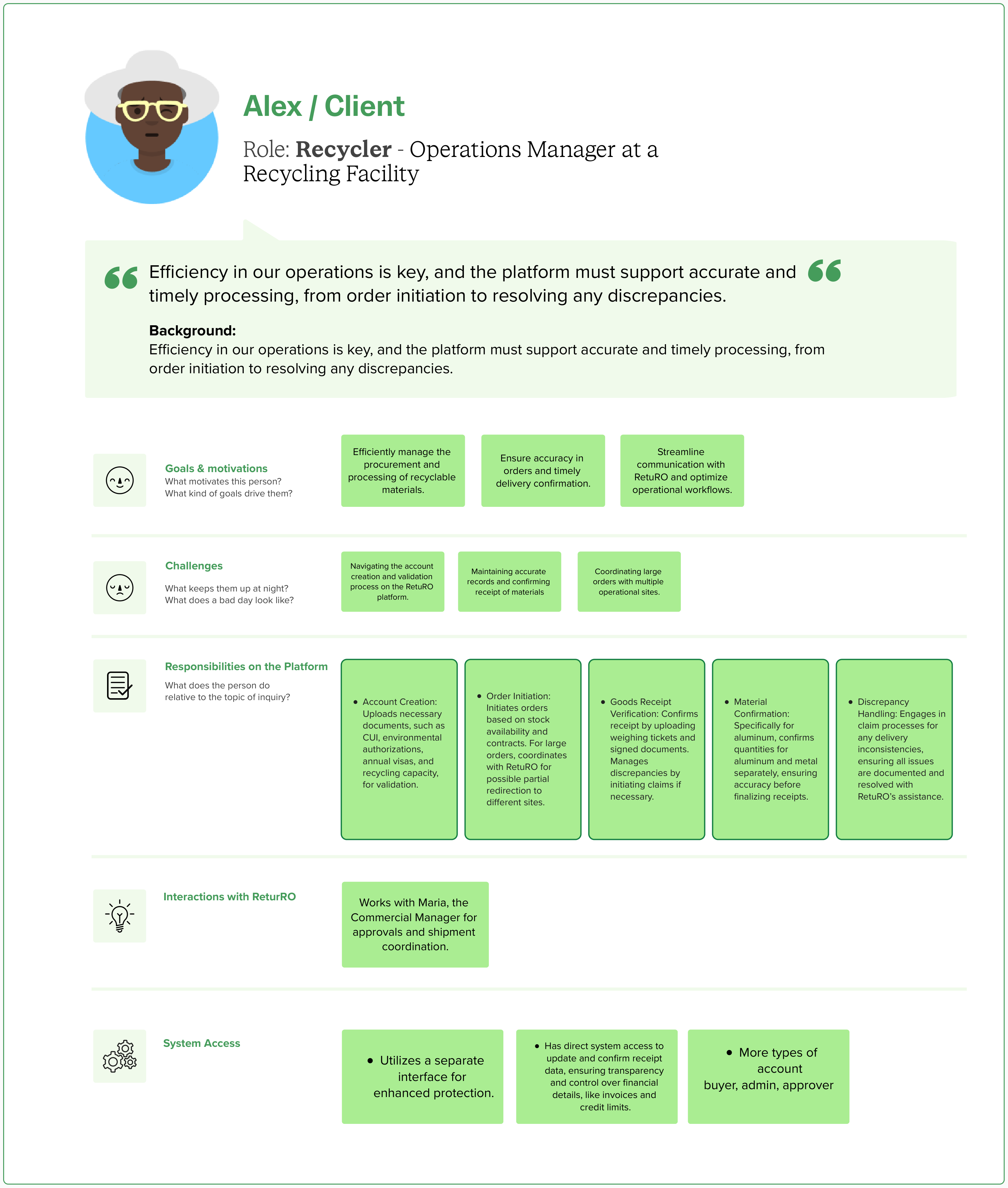
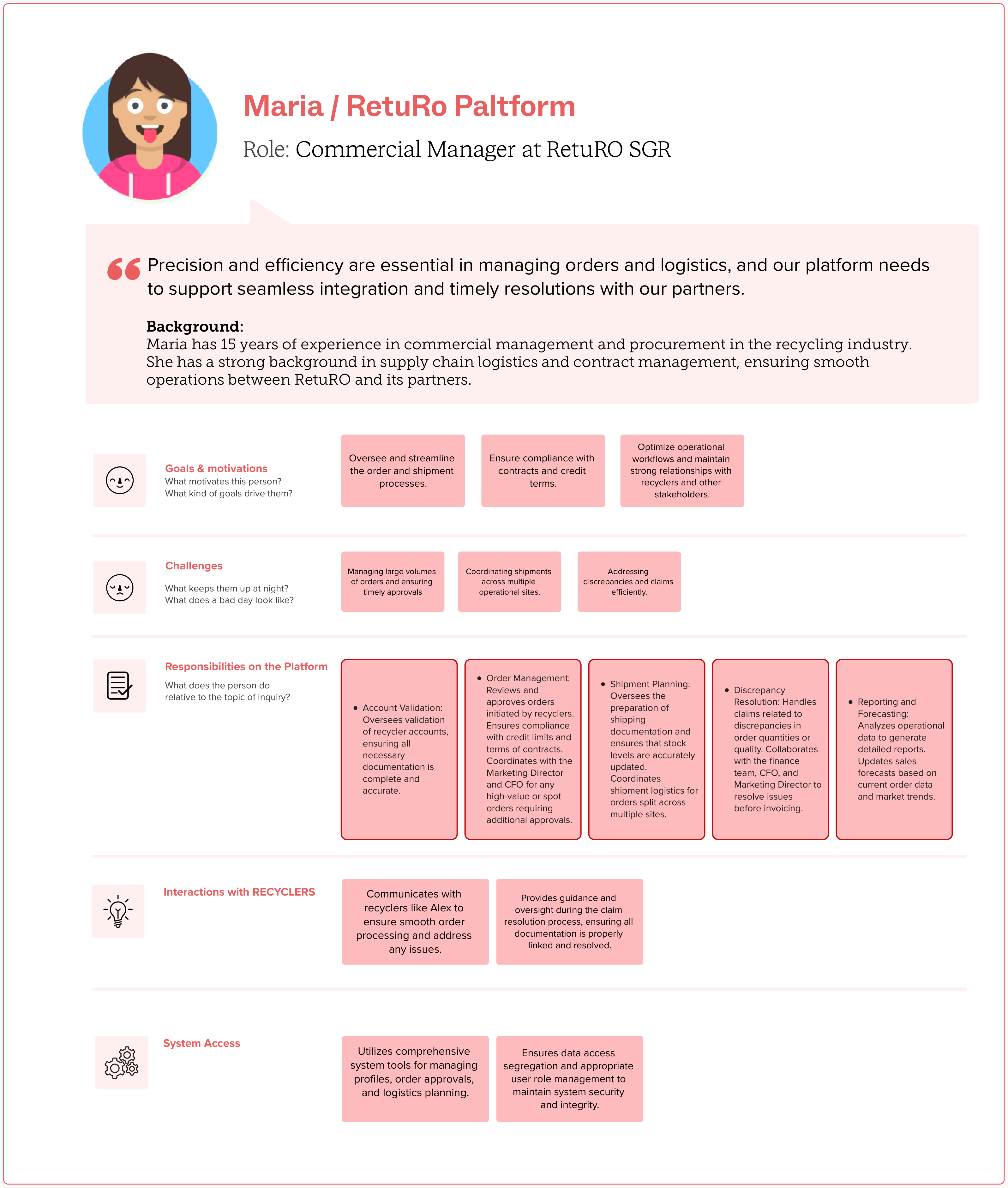
Artefact: Personas extracted during client workshop

DEFINE & SOLUTION

Define

Based on the research we defined the following priorities: intuitive interfaces for diverse user roles, a significant reduction in order processing time and data entry errors, resolution of the bottlenecks users face in order management and support, and the opportunity to leverage AI to streamline interactions, enhance accuracy, and improve decision-making.

Solution

Real-time dashboards monitor collection points, sorting centres, and stock levels across material types. Order management is simplified with an intuitive interface for viewing, approving, or rejecting orders, with timely notifications. Financial dashboards deliver clear insights into revenue, expenses, and profitability, while integration with accounting systems streamlines invoice and payment processes. Interactive maps offer geographical views of stock distribution across RVM machines and processing plants. A material marketplace allows users to browse and find waste materials by type, grade, and price.

AI INTEGRATION

Strategic recommendations proposed beyond the RFP scope

Beyond the functional requirements of the RFP, I identified four AI-driven directions that could significantly enhance user efficiency and platform intelligence. These were included as strategic recommendations in the proposal.

Predictive Analytics

Intuitive dashboards displaying forecasted trends and inventory suggestions, helping users make informed decisions quickly. AI models analyse historical data and market trends to improve accuracy in sales forecasting and inventory management.

AI Chatbots for Support

Conversational interfaces enabling users to get real-time assistance and guidance, enhancing the overall support experience without relying on IT escalation.

KEY DESIGN DECISIONS

Strategic calls made under constraint — not just design execution

1

Built our own design library — rejected Bupa's 7 inconsistent files

They were inconsistent, overlapping, and unmaintainable at scale. As a design team we made the decision to build a single, structured two-file system from scratch — aligned with Bupa Global DS principles but rebuilt for consistency, scalability, and developer handoff.

Team decision

Design leadership

Token-first system

2

Redesigned key flows within GIL and SWAN constraints

Legacy backend systems (GIL and SWAN) imposed hard limits on what could be built. Rather than working around constraints at surface level, we redesigned the underlying flows — commission tracking, claims submission, user admin — to deliver modern UX within the technical boundaries, not despite them.

Flow redesign

Legacy constraints

GIL · SWAN

3

Delivered to production without complete requirements

Requirements were not finalised when design work began. Rather than blocking delivery, we started with what was known — accepting that extra iterations would follow. This decision kept the project moving and allowed development to begin while design continued to evolve. Multiple iteration rounds were built into the process from the start.

Agile delivery

Extra iterations

Production delivery

4

Multi-stage approval — internal critique → BA → SME sign-off

Design proposals went through internal team critique before reaching stakeholders. Multiple design directions were explored and debated internally — only the strongest proposals moved forward to Business Analysts and Subject Matter Experts for approval. This process ensured design decisions were evidence-based before entering stakeholder review.

Internal critique

BA approval

SME sign-off

Stakeholder management

USER FLOWS - UI

Built from scratch · Aligned with Bupa Global Design System

Tokens and components are separated following enterprise best practice — tokens can be updated without touching component structure living in a sepaeate file in Figma, and components can evolve without breaking the token layer. This mirrors how the system

is consumed in code: tokens as variables, components as implementations

REFLECTION

What I learned

Bupa taught me that the most complex UX challenge isn't designing for users - it's designing within systems that weren't built for modern UX. Navigating GIL and SWAN sharpened my ability to advocate for design decisions with technical rationale. The user interviews revealed that manual workarounds had become standard - a sign of systemic UX debt that needed architectural change, not just Ul polish.

RANOSEMI

Home

Case studies

About

Contact

Automated solution for sales of finished goods to recyclers

Sole UX Designer · Tremend Proposal

Circular Economy · Waste Management

Discovery Workshop · Service Blueprint · Low-fidelity Prototype

Web · B2B Enterprise

Returo dashboard

IMPACT AND LEAD OUTCOME

Designed as part of a competitive RFP response for Romania's national deposit-return system administrator. All metrics represent design targets established through research benchmarking and client brief analysis.

50%

Faster task completion through AI-driven interfaces

30%

Improvement in user satisfaction

40%

Error rate reduction

25%

Reduction in system downtime

95%

Data synchronisation accuracy achieved

3→1

Order processing time reduced from 3 days to 1 day

CONTEXT

The challenge

RetuRO SGR is Romania's government-appointed administrator of the national Deposit-Return System, managing the collection, sorting, and sale of plastic, metal and glass across multiple national centres. The project required a fully integrated platform connecting recyclers, commercial managers, and IT teams — with deep integration into Microsoft Dynamics and UI deliverables constrained by DRUPAL's rendering limitations.

My contribution

I contributed across product strategy and UX— from market research, KPI definition, andpersona development through journey mapping,UX enhancement strategy, and high-fidelitymobile screen design. Part of the front-endand mobile design lead at Tremend · Publicis.

DISCOVERY

Service blueprint

To map the full complexity of RetuRO's sales process, I created a service blueprint covering three operational phases and eleven steps — from master data administration through to reporting and forecasting. Each step was mapped against the three user personas and automated system touchpoints, making visible where handoffs, delays, and validation bottlenecks occurred.

Semantic naming

Semantic naming

Semantic naming

CTA IMAGE

Artefact: Mural service blueprint image with persona swimlanes

USER RESEARCH - PERSONAS

Three distinct user types with divergent platform needs

Persona insights were derived from RFP documentation and stakeholder analysis rather than direct user interviews — a constraint of the proposal context that I navigated by grounding each persona in the operational responsibilities and pain points described in the client brief.
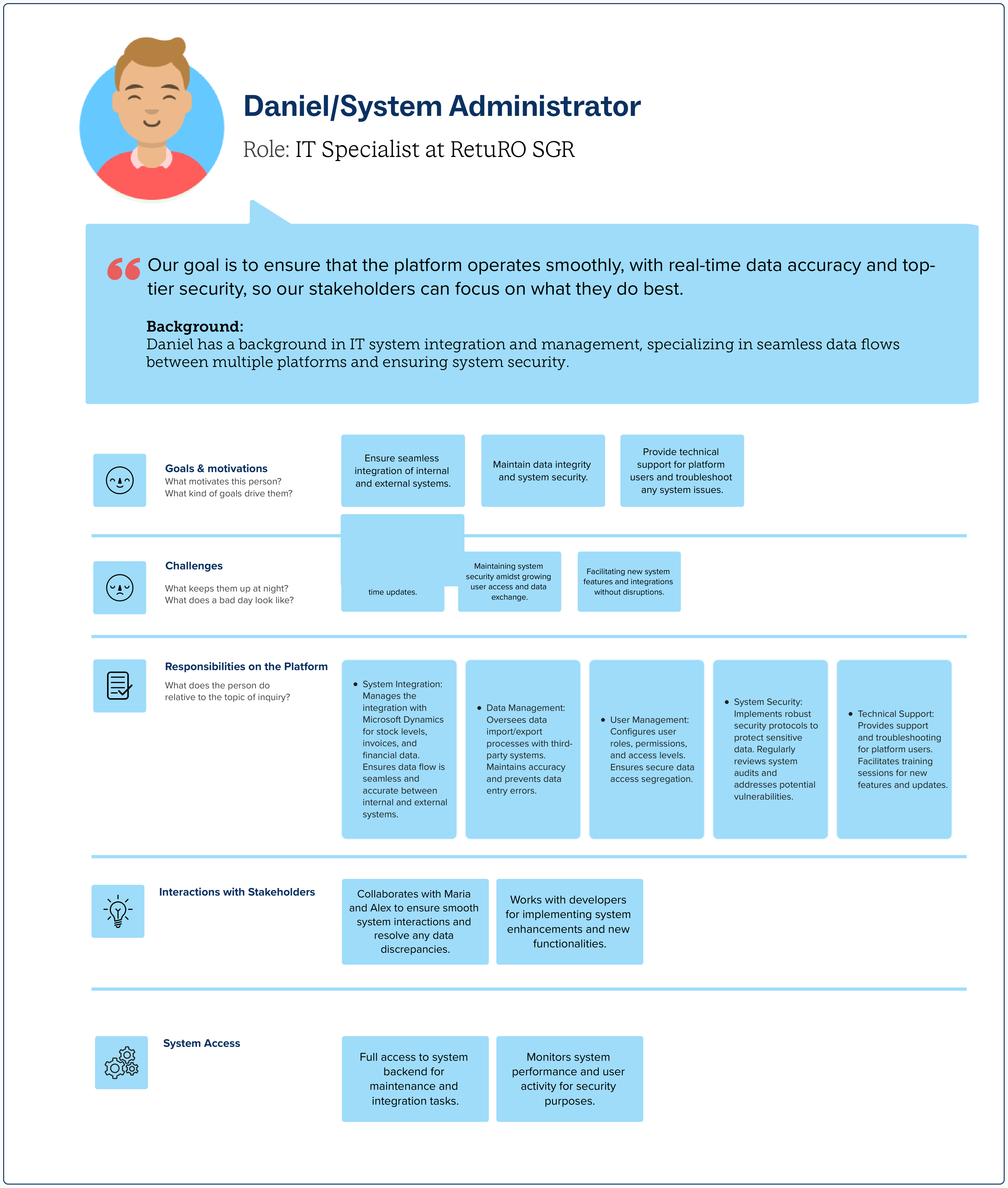
Artefact: Personas extracted during client workshop

DEFINE & SOLUTION

Define

Based on the research we defined the following priorities: intuitive interfaces for diverse user roles, a significant reduction in order processing time and data entry errors, resolution of the bottlenecks users face in order management and support, and the opportunity to leverage AI to streamline interactions, enhance accuracy, and improve decision-making.

Solution

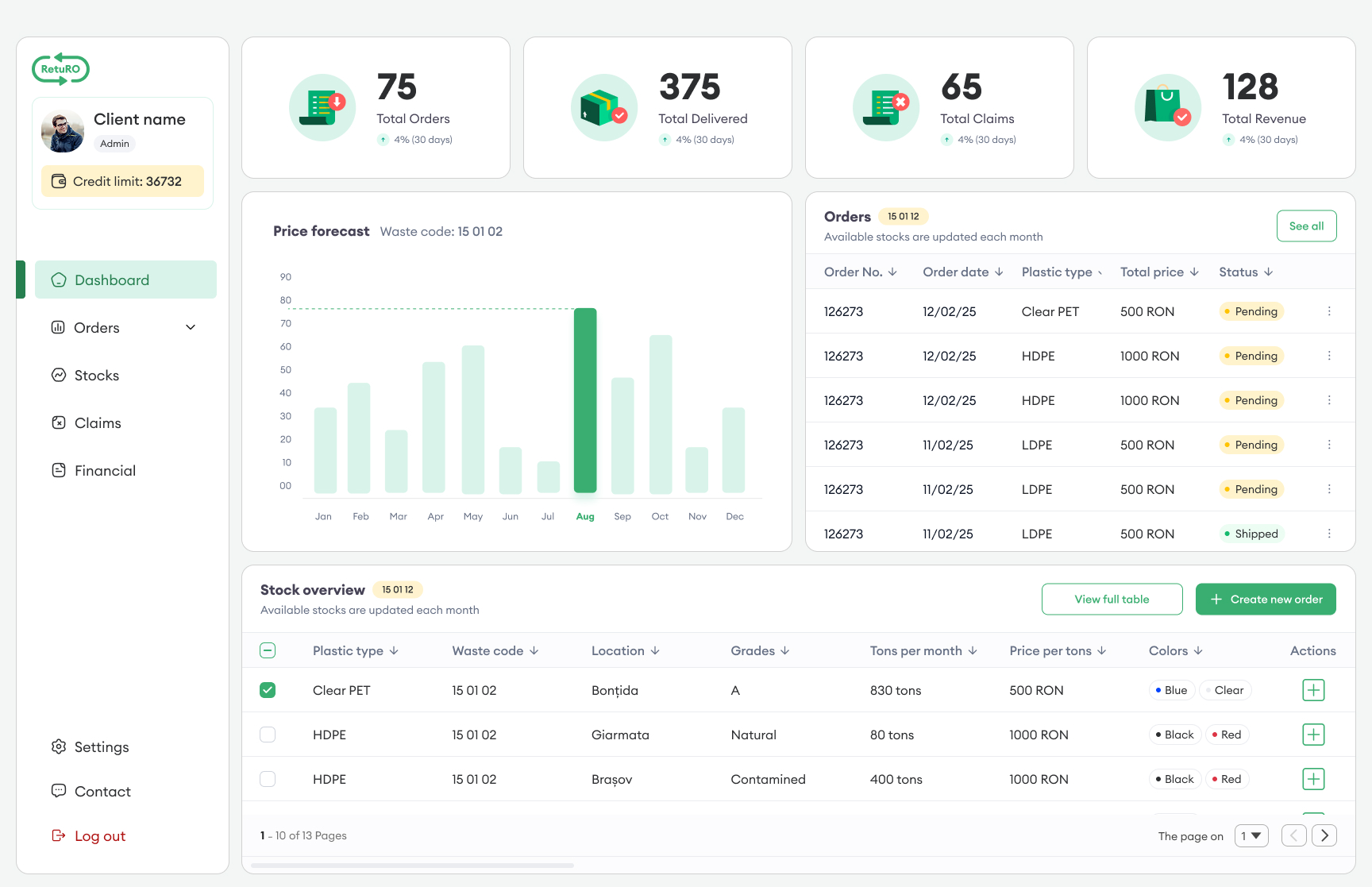
Real-time dashboards monitor collection points, sorting centres, and stock levels across material types. Order management is simplified with an intuitive interface for viewing, approving, or rejecting orders, with timely notifications. Financial dashboards deliver clear insights into revenue, expenses, and profitability, while integration with accounting systems streamlines invoice and payment processes. Interactive maps offer geographical views of stock distribution across RVM machines and processing plants. A material marketplace allows users to browse and find waste materials by type, grade, and price.

AI INTEGRATION

Strategic recommendations proposed beyond the RFP scope

Beyond the functional requirements of the RFP, I identified four AI-driven directions that could significantly enhance user efficiency and platform intelligence. These were included as strategic recommendations in the proposal.

Predictive Analytics

Intuitive dashboards displaying forecasted trends and inventory suggestions, helping users make informed decisions quickly. AI models analyse historical data and market trends to improve accuracy in sales forecasting and inventory management.

AI Chatbots for Support

Conversational interfaces enabling users to get real-time assistance and guidance, enhancing the overall support experience without relying on IT escalation.

KEY DESIGN DECISIONS

Strategic calls made under constraint — not just design execution

1

Built our own design library — rejected Bupa's 7 inconsistent files

They were inconsistent, overlapping, and unmaintainable at scale. As a design team we made the decision to build a single, structured two-file system from scratch — aligned with Bupa Global DS principles but rebuilt for consistency, scalability, and developer handoff.

Team decision

Design leadership

Token-first system

2

Redesigned key flows within GIL and SWAN constraints

Legacy backend systems (GIL and SWAN) imposed hard limits on what could be built. Rather than working around constraints at surface level, we redesigned the underlying flows — commission tracking, claims submission, user admin — to deliver modern UX within the technical boundaries, not despite them.

Flow redesign

Legacy constraints

GIL · SWAN

3

Delivered to production without complete requirements

Requirements were not finalised when design work began. Rather than blocking delivery, we started with what was known — accepting that extra iterations would follow. This decision kept the project moving and allowed development to begin while design continued to evolve. Multiple iteration rounds were built into the process from the start.

Agile delivery

Extra iterations

Production delivery

4

Multi-stage approval — internal critique → BA → SME sign-off

Design proposals went through internal team critique before reaching stakeholders. Multiple design directions were explored and debated internally — only the strongest proposals moved forward to Business Analysts and Subject Matter Experts for approval. This process ensured design decisions were evidence-based before entering stakeholder review.

Internal critique

BA approval

SME sign-off

Stakeholder management

USER FLOWS - UI

Built from scratch · Aligned with Bupa Global Design System

Tokens and components are separated following enterprise best practice — tokens can be updated without touching component structure living in a sepaeate file in Figma, and components can evolve without breaking the token layer. This mirrors how the system

is consumed in code: tokens as variables, components as implementations
REFLECTION

What I learned

Bupa taught me that the most complex UX challenge isn't designing for users - it's designing within systems that weren't built for modern UX. Navigating GIL and SWAN sharpened my ability to advocate for design decisions with technical rationale. The user interviews revealed that manual workarounds had become standard - a sign of systemic UX debt that needed architectural change, not just Ul polish.

RANOSEMI

Home

Case studies

About

Contact

Automated solution for sales of finished goods to recyclers

Sole UX Designer · Tremend Proposal

Circular Economy · Waste Management

Discovery Workshop · Service Blueprint · Low-fidelity Prototype

Web · B2B Enterprise

Returo dashboard

IMPACT AND LEAD OUTCOME

Designed as part of a competitive RFP response for Romania's national deposit-return system administrator. All metrics represent design targets established through research benchmarking and client brief analysis.

50%

Faster task completion through AI-driven interfaces

30%

Improvement in user satisfaction

40%

Error rate reduction

25%

Reduction in system downtime

95%

Data synchronisation accuracy achieved

3→1

Order processing time reduced from 3 days to 1 day

CONTEXT

The challenge

RetuRO SGR is Romania's government-appointed administrator of the national Deposit-Return System, managing the collection, sorting, and sale of plastic, metal and glass across multiple national centres. The project required a fully integrated platform connecting recyclers, commercial managers, and IT teams — with deep integration into Microsoft Dynamics and UI deliverables constrained by DRUPAL's rendering limitations.

My contribution

As sole UX designer on Tremend's proposal team, I led the end-to-end UX process across discovery, persona development, service blueprint mapping, user flow design, and high-fidelity UI production — all delivered under RFP timeline constraints.

DISCOVERY

Service blueprint

To map the full complexity of RetuRO's sales process, I created a service blueprint covering three operational phases and eleven steps — from master data administration through to reporting and forecasting. Each step was mapped against the three user personas and automated system touchpoints, making visible where handoffs, delays, and validation bottlenecks occurred.

3 phases

11 steps

persona swimlanes

Artifact: Mural service blueprint image with persona swimlanes

USER RESEARCH - PERSONAS

Three distinct user types with divergent platform needs

Persona insights were derived from RFP documentation and stakeholder analysis rather than direct user interviews — a constraint of the proposal context that I navigated by grounding each persona in the operational responsibilities and pain points described in the client brief.

Artifact: Personas extracted during client workshop

DEFINE & SOLUTION

Define

Based on the research we defined the following priorities: intuitive interfaces for diverse user roles, a significant reduction in order processing time and data entry errors, resolution of the bottlenecks users face in order management and support, and the opportunity to leverage AI to streamline interactions, enhance accuracy, and improve decision-making.

Solution

Real-time dashboards monitor collection points, sorting centres, and stock levels across material types. Order management is simplified with an intuitive interface for viewing, approving, or rejecting orders, with timely notifications. Financial dashboards deliver clear insights into revenue, expenses, and profitability, while integration with accounting systems streamlines invoice and payment processes. Interactive maps offer geographical views of stock distribution across RVM machines and processing plants. A material marketplace allows users to browse and find waste materials by type, grade, and price.

AI INTEGRATION

Strategic recommendations proposed beyond the RFP scope

Beyond the functional requirements of the RFP, I identified four AI-driven directions that could significantly enhance user efficiency and platform intelligence. These were included as strategic recommendations in the proposal.

Predictive Analytics

Intuitive dashboards displaying forecasted trends and inventory suggestions, helping users make informed decisions quickly. AI models analyse historical data and market trends to improve accuracy in sales forecasting and inventory management.

Automated Data Entry & Validation

Seamless upload interfaces where AI automatically checks document accuracy, providing instant feedback and reducing manual input errors at the point of entry.

AI Chatbots for Support

Conversational interfaces enabling users to get real-time assistance and guidance, enhancing the overall support experience without relying on IT escalation.

Personalised Recommendations

Tailored suggestions for order patterns and supplier choices, displayed in an easy-to-navigate interface — helping recyclers and commercial managers act faster on recurring decisions.

KEY DESIGN DECISIONS

Strategic calls made under constraint — not just design execution

1

Built our own design library — rejected Bupa's 7 inconsistent files

They were inconsistent, overlapping, and unmaintainable at scale. As a design team we made the decision to build a single, structured two-file system from scratch — aligned with Bupa Global DS principles but rebuilt for consistency, scalability, and developer handoff.

Team decision

Design leadership

Token-first system

2

Redesigned key flows within GIL and SWAN constraints

Legacy backend systems (GIL and SWAN) imposed hard limits on what could be built. Rather than working around constraints at surface level, we redesigned the underlying flows — commission tracking, claims submission, user admin — to deliver modern UX within the technical boundaries, not despite them.

Flow redesign

Legacy constraints

GIL · SWAN

3

Delivered to production without complete requirements

Requirements were not finalised when design work began. Rather than blocking delivery, we started with what was known — accepting that extra iterations would follow. This decision kept the project moving and allowed development to begin while design continued to evolve. Multiple iteration rounds were built into the process from the start.

Agile delivery

Extra iterations

Production delivery

4

Multi-stage approval — internal critique → BA → SME sign-off

Design proposals went through internal team critique before reaching stakeholders. Multiple design directions were explored and debated internally — only the strongest proposals moved forward to Business Analysts and Subject Matter Experts for approval. This process ensured design decisions were evidence-based before entering stakeholder review.

Internal critique

BA approval

SME sign-off

Stakeholder management

USER FLOWS - UI

Built from scratch · Aligned with Bupa Global Design System

Tokens and components are separated following enterprise best practice — tokens can be updated without touching component structure living in a separate file in Figma, and components can evolve without breaking the token layer. This mirrors how the system is consumed in code: tokens as variables, components as implementations.

REFLECTION

What I learned

Bupa taught me that the most complex UX challenge isn't designing for users - it's designing within systems that weren't built for modern UX. Navigating GIL and SWAN sharpened my ability to advocate for design decisions with technical rationale. The user interviews revealed that manual workarounds had become standard - a sign of systemic UX debt that needed architectural change, not just Ul polish.